Is There A Spell For Paying Attention?
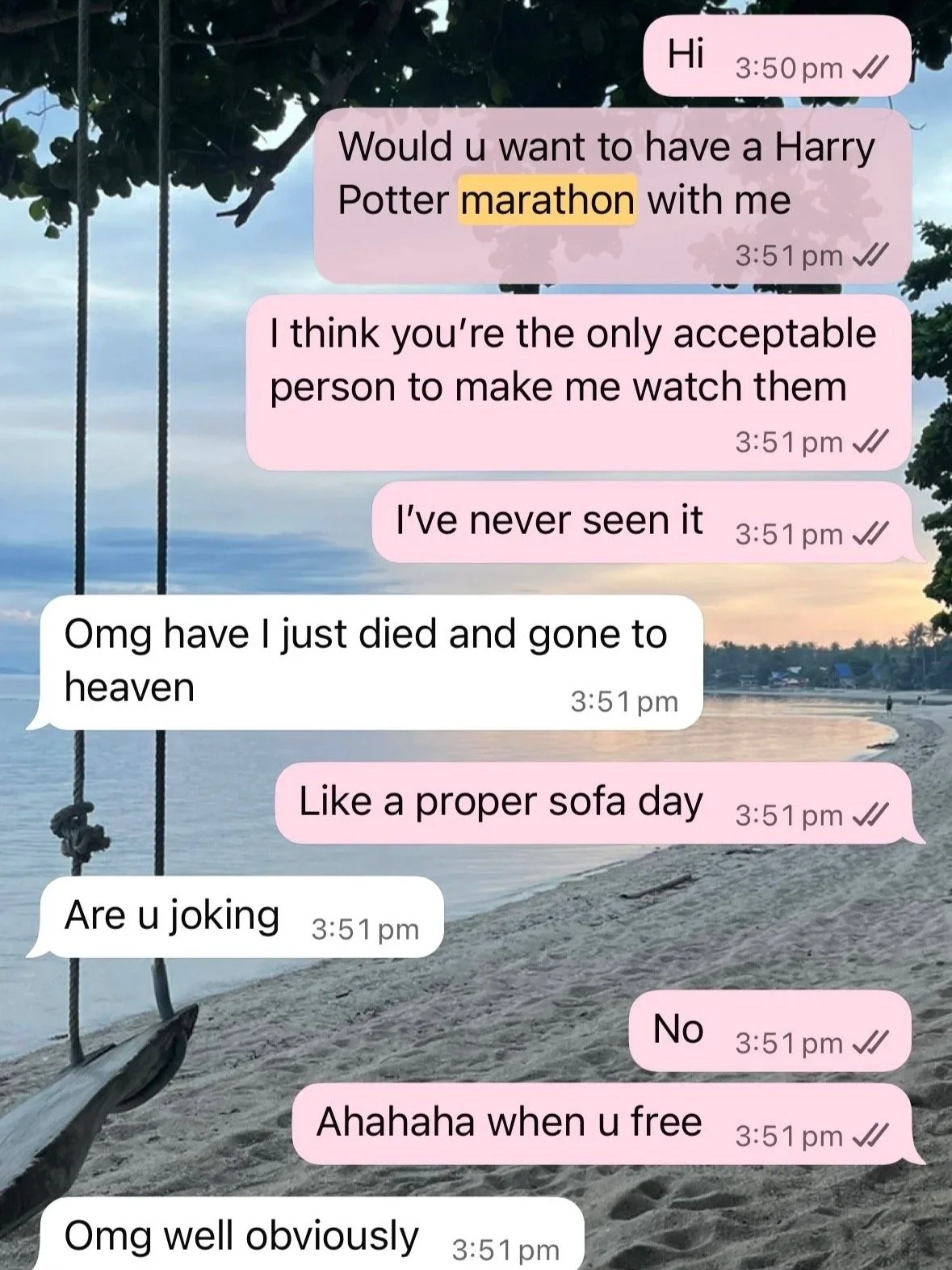
Harry Potter is a cultural phenomenon for most people. Yet up until two weeks ago, I had never seen a Harry Potter film. I always dismissed it as something I wouldn’t enjoy due to my lack of interest in the genre. But with multiple people expressing their disbelief that I had never seen it, I decided twenty-three was the time to embark on my Harry Potter journey.
And luckily, I already knew the perfect person for the task. My best friend and potentially the world’s biggest Harry Potter geek.
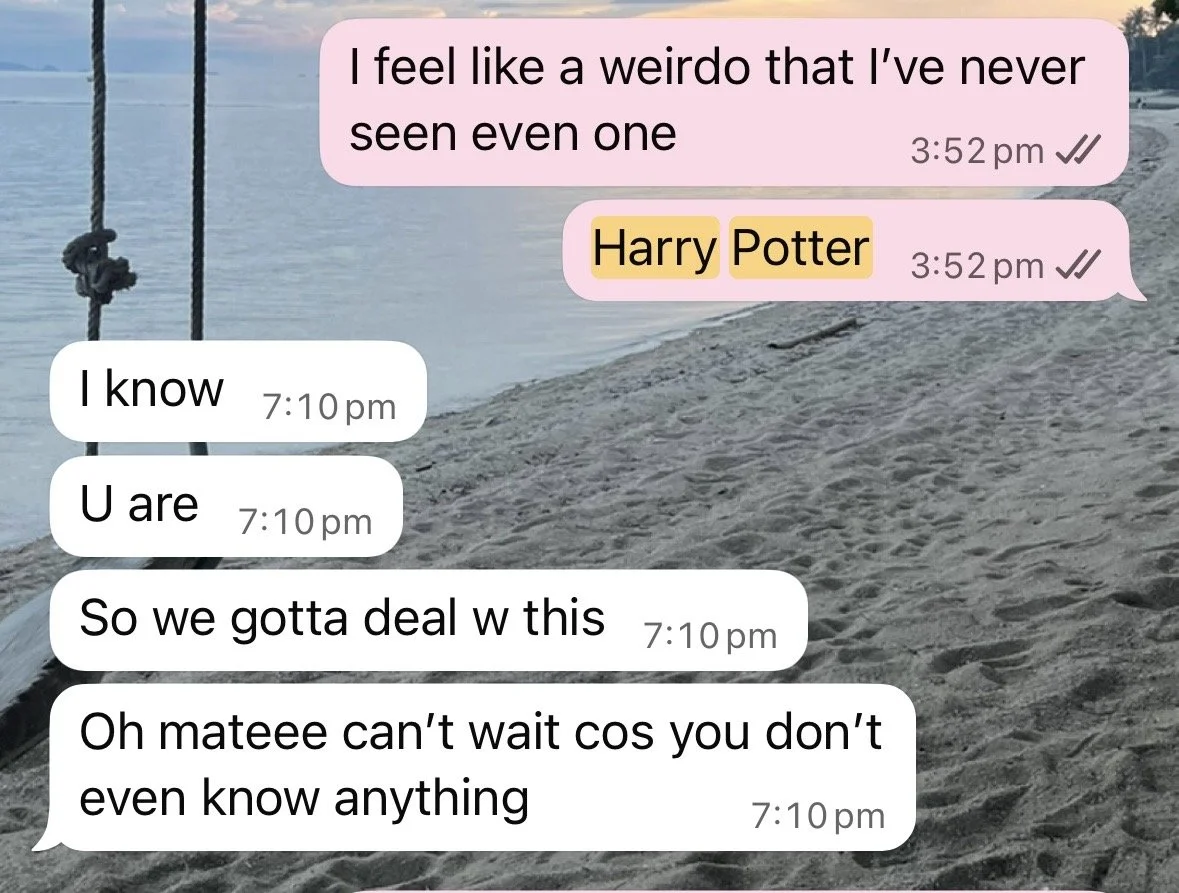
I’ve attached my proposal of a Harry Potter marathon with her for your benefit!
She gave me fair warning that it may be cringe at times and urged me to just ‘bear with it.’ Yet, aside from the occasional sneer at some outdated acting, I absolutely fell in love with Harry Potter. But perhaps not for the reason you’d assume…
Weirdly, Harry Potter got me thinking about the effect social media and AI has had on the attention span of our generation. Since leaving my job a few weeks ago, I’ve become more aware of my screentime. Procrastination and boredom seems to lead to aimless scrolling and it’s shocked me to see just how much time we can waste doing literally nothing.
The fleeting nature of social media allows us to consume thousands of thirty second videos in no time. When I’m deep into a ‘doom scroll’, any video over a minute long can sometimes leave me bored and wanting to skip to see the ending. Or even worse, scrolling to the next video before I can even see the ending, despite if i’m interested or not. It’s sad because the majority of the time we’re watching videos that teach us nothing – now more commonly known as ‘brain rot.’
So, if you’re reading this… could re-watching (or in my case, watching) Harry Potter fix our struggling attention spans?
With my best friend desperate for me to enjoy her favourite films and an acute understanding of how seriously she took this, I knew being on my phone was simply not an option. (She would have paused it and stared me down until I gave my full attention… trust me!)
However, this was never an issue because the Harry Potter films demanded my attention naturally, and even maintained it throughout eight films spanning two and a half hours long each. I became completely engrossed from the first film, plotting up possible theories and growing deeply attached to the characters. (Yes, I would literally die for Hagrid)
Straight away, I loved how nothing was explained instantly. It expects you to pay attention and trusts that you’ll remember the important details, with satisfaction being the reward. In the same way, nothing is that predictable. I kept saying to my friend, “I can’t figure out if Snape is a goodie or a baddie” to later find out that this was, of course, entirely intentional. I found it refreshing to not only spend time questioning the ‘what-if’s’, but to actually want to do so.
Similarly, Harry Potter reminded me how easy it is to forget the value of imagination and creativity. The sheer scale of Rowling's imagination is so impressive it almost seems unfathomable, a skill I believe is determined by her immaculate attention to detail.
An old boarding school housed in a castle, fierce sporting rivalries and familiar school cliques all combine to make this entirely fictional world feel strangely relatable. But more importantly, Rowling has covered the logistics to her fictional world. Every spell has rules, every magical item has a purpose and there are politics to magic, not only making everything internally consistent but all the more tangible. The truly impressive part lies in Rowling never asking you to believe that magic exists but masterfully creating a palpable world depicting exactly what it would look like if it were to.
Undoubtedly, Harry Potter is filled with magic, nostalgia and deep senses of loyalty. The relationships in the Harry Potter films underpin the overwhelming messages of honesty and love as the ultimate power. But what struck me most is how universal and real these feelings and takeaways are despite unfolding in an entirely fictional world. Somehow, the magical setting doesn't distance you from the story; it draws you closer to it. The fantasy simply becomes the backdrop for experiences that every one of us can recognise. To me, this is why imagination and creativity are the true brilliance of Harry Potter as J.K. Rowling created something completely fantastical that still feels emotionally authentic.
Thus, against our current reality, which is a world that’s become heavily reliant on artificial intelligence and digital media to think, answer and create for us, Harry Potter was a profound reminder to the power and importance of human imagination and creativity.
Regardless of what age you are when watching Harry Potter, it is easy to appreciate the skill and intelligence behind it. This started as an idea inside of a singular person's brain and has snowballed into arguably one of the most widely recognised book and film franchises of all time. It seems obvious now that this is why Harry Potter has endured success and credibility for so long.
Whilst it’s sad to admit, I think most of us are guilty of glancing at our phones while watching something as we’ve become so used to consuming multiple things at once. But for the first time in a long time, I didn’t feel the urge to pick up my phone while watching Harry Potter. So, although our attention is often captured in 30 second bursts online, this kind of immersion feels progressively rare but incredibly valuable.
These days we have access to everything quite literally at our fingertips and too much information can be overwhelming at times. We skim read chunks of information or skip boring parts of the film in search for something more relevant or exciting. However, context and storylines matter. Harry’s complicated world predates him and starts years before he was born, so as an audience we must not only know this, but feel it. This is one of Harry Potter’s biggest strengths – how alive it is. You build theories, try to fill in gaps, ask questions and become willing to wait patiently until it unravels naturally.
So, if I’m being honest, I started this marathon simply to find out what all the fuss was about. But I finished it understanding that imagination and attention go hand in hand, with creativity only flourishing when we’re willing to pay attention. Therefore, in a world that constantly encourages us to scroll, skim and consume, maybe we should spend a little more time imagining, creating and paying attention.
Take this as your sign to binge Harry Potter, again, or for the first time!